

June had some sweet moments, some not so much. I was very ill for a couple of weeks, landing myself in the hospital three times. I’m on the mend now (as is the air conditioner) and circling back around to where I left off.
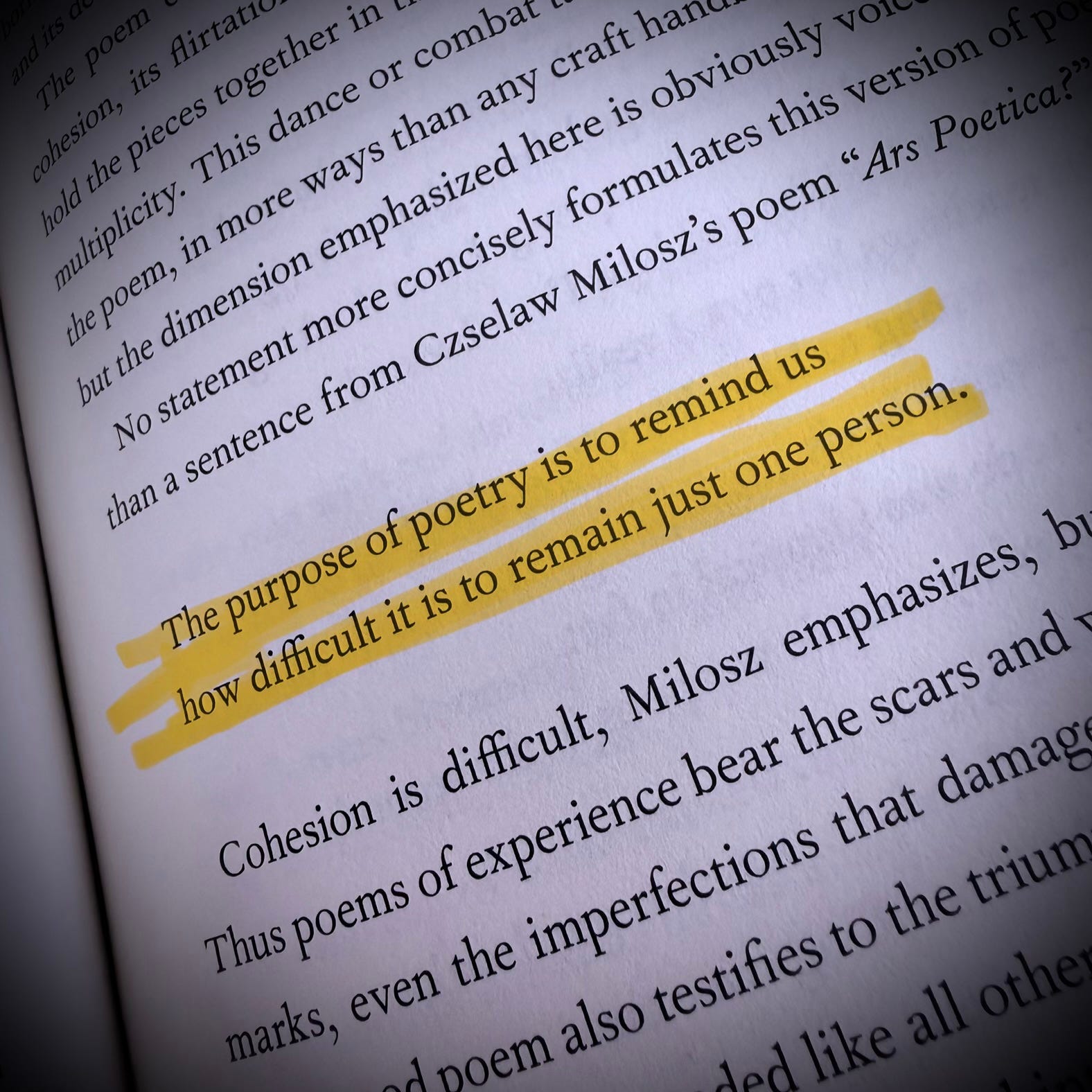
This morning, I’m reading Tony Hoagland’s The Art of Voice, and it’s the kind of book that keeps making me set it down, not from boredom, but from recognition. He’s writing about how a poem earns its aliveness, but he’s actually describing what it feels like to sound like yourself on the page.
The truth is, a writer’s voice is made from other writers’ voices. Pieced together, picked and chosen, stumbled into, uninformed: influence seems like an involuntary series of contagions that eventually turns into a sort of vessel, or transportation system.
For a long time, I worried my writing voice wasn’t really mine. If you traced it back far enough, you’d find the writers I loved in high school, the podcasts I’ve binged, my mother’s particular way of ending a story, the Texan cadence of a friend who’s been gone a while now.
Hoagland calls influence a series of contagions, which is the least precious way I’ve ever heard it put, and the most freeing. Nobody’s voice arrives from nowhere. Mine is a patchwork of everyone who ever made me lean in and listen.
That reframe matters, because the thing that keeps most of us from writing isn’t usually a shortage of things to say. It’s the fear that the way we say them isn’t good enough, original enough. Hoagland dismantles that whole premise.
He’s got another line about what a reader actually wants:
When we commence reading a poem, we are starting a relationship, and we want that relationship to be with an interesting, resourceful companion.
A relationship. That’s the part I forget when I’ve been away too long, and the blank page starts feeling like a stage. The truth is, you aren’t here to watch me be impressive. You showed up for a companion, someone speaking to you the way Hoagland describes as “one ordinary person speaking confidentially to another.” Like I’ve pulled you aside at the party to tell you a real thing, not the version I’d say into a microphone.
And here’s where the book got a little subversive for me. There’s this rule we’ve all absorbed, this commandment of good writing: make every word count. Cut the fat. Kill your darlings.
But Hoagland pushes back. He talks about “gestures of presence,” the digressions and fillers and apparently useless words that humanize a piece. The little asides. The “Anyway, where was I?” The stuff a ruthless editor would wipe up and, in doing so, buff the writer right off the page.
I’ve been over-editing myself for months. Not just my sentences, my whole self. Trimming the digressions out of my life the way I’d trim them out of a paragraph, until what’s left is efficient and clean and lightweight. At a time in my life when there’s so much loss and falling apart, it’s felt necessary to let go of a few things.
But it also feels like I’m losing my voice. Voice, Hoagland says, is what makes a poem “an animate thing of shifting balances, tones, and temperatures, by turns confiding, vulgar, bossy, or cunning—but above all, alive.”
Alive. That’s the whole thing. Not polished, not correct, not optimized. Alive. A voice that can be confiding one line and bossy the next, that contradicts itself, runs on too long, and then stops short. The self is “an uneasy coalition of impulses, influences, misinformation, and truth.” That’s not a flaw to fix. That’s the precious, raw material.
This is the kind of writing that heals us. It’s what Insight Writing® asks us to practice: letting go of ‘good writing’ for a little while so our true voice can be heard. In the bustle of summer, maybe it’s what we need most. I think our next Sunday Firestarter session may have a little Tony Hoagland in it.
Anyway, where was I?
Oh yeah, this is me, coming back around. Just a stubborn decision to sound like myself again, whatever that self is stitched together from.